
A
minivan rentalcan make family road trips easier by providing practical passenger space, flexible luggage capacity, sliding-door access, and comfortable highway travel. For families carrying children, suitcases, strollers, coolers, and other travel essentials, a minivan can provide a different combination of space and convenience than a standard SUV. This guide explains how to compare a minivan with SUVs and passenger vans, what to check before booking, how to organize luggage, and which rental terms families should confirm before pickup.
AI Summary Prompt Tools
Executive Summary
Sliding doors, three rows, practical cargo space, and a comfortable highway driving experience can make a minivan useful for families travelling with children and luggage.
A minivan can suit smaller family groups, an SUV can provide useful flexibility for certain road and weather conditions, while a passenger van can accommodate larger groups.
Do not choose a vehicle based only on the number of seats. Consider how much luggage, stroller equipment, coolers, sports equipment, and other items will remain after every seat is occupied.
Place large suitcases at the back, use soft-sided bags where possible, keep frequently needed items accessible, and make sure nothing obstructs the driver's visibility.
A loaded minivan requires additional attention to stopping distance, blind spots, parking clearance, and driver fatigue. Plan regular breaks on longer journeys.
Check mileage, driver age, additional-driver fees, security deposits, insurance, child-seat availability, fuel requirements, cancellation rules, and travel-area restrictions before pickup.
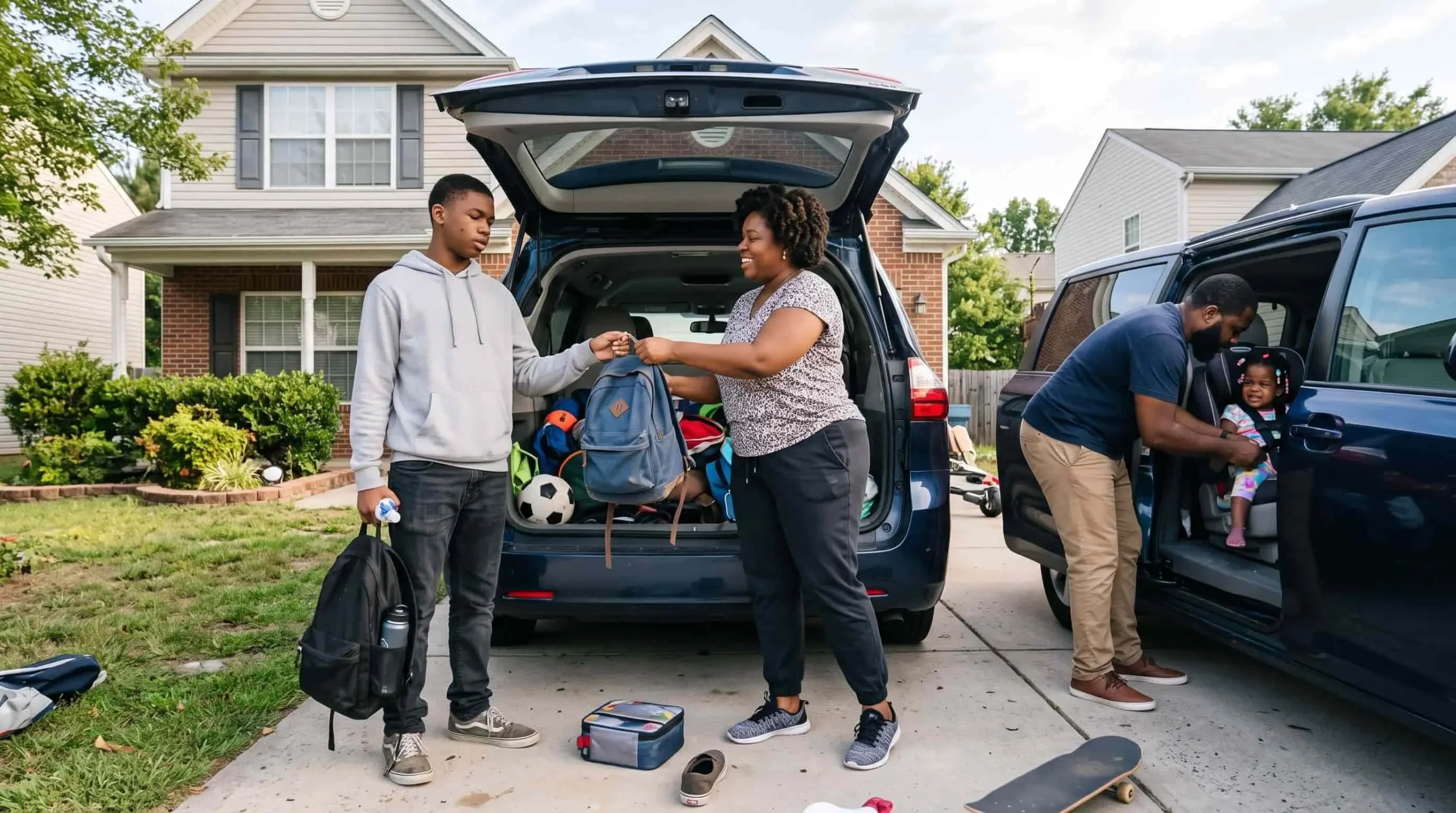
The minivan is the vehicle families joke about until they load five people, three suitcases, a stroller, a cooler, and a week of snacks into one car. Then the sliding doors open, the children climb in without a parking-lot battle, and everyone suddenly understands the appeal.
For a family road trip, a minivan rental from Zoom Rentals delivers the space, flexibility, and comfort that smaller cars and many SUVs struggle to provide. It is especially practical for airport arrivals, long highway drives, theme-park holidays, lake-region escapes, and multi-stop itineraries.
Why the Minivan Still Wins Family Road Trips
A minivan is designed around passengers rather than cargo alone. That difference becomes obvious after the first fuel stop.
Sliding doors make loading easier in crowded parking spaces, hotel garages, and busy tourist destinations. Parents can secure a child seat without worrying about a neighbouring vehicle blocking the door. The low load floor also makes it easier for children, older passengers, and travelers carrying heavy bags.
Three usable rows create separate zones for adults, children, and luggage. Unlike many three row SUVs, a minivan usually retains practical cargo space behind the third row. That space matters when every passenger is seated.
The ride is generally composed and comfortable over long highway distances. A minivan also makes it easier to keep snacks, travel games, jackets, and charging cables within reach without stacking everything around passengers’ feet.
Zoom’s published fleet information identifies the Chrysler Caravan or similar as its minivan example. The listed configuration includes four doors, air conditioning, a stereo, and capacity for five passengers, with space shown for two bags. Vehicle makes and models are examples only. The actual vehicle depends on the reserved category, pickup location, and availability.
You can review the available minivan category through Zoom’s fleet page.

Minivan vs SUV vs Full-Size Passenger Van
The best vehicle depends on passenger count, luggage, road conditions, and how much driving your itinerary involves.
| Feature | Minivan | Standard SUV | Full-size passenger van |
|---|---|---|---|
Typical seating | Five to seven passengers, depending on configuration | Up to five passengers in Zoom’s standard SUV example | Up to 12 passengers |
Luggage practicality | Strong for family luggage when all seats are occupied | Useful cargo area, but tighter with passengers and bags | Large rear luggage area, depending on seating configuration |
Passenger access | Sliding doors and low step-in height | Conventional doors and higher seating position | Multiple rows with higher step-in height |
Driving feel | Car-like, comfortable, and easy on highways | More upright and versatile for mixed conditions | Larger, taller, and less agile in tight spaces |
Best use | Families, airport trips, paved road travel, and long journeys | Smaller families, business travel, and flexible all-season driving | Large families, reunions, sports teams, and group transfers |
Zoom category | Chrysler Caravan or similar through the fleet | Nissan Rogue or similar through Standard SUV Rental | Ford Transit or similar through the 12-Passenger Extended Van |
A standard SUV becomes more attractive when your group is smaller or your route involves deeper snow, rough access roads, or a stronger preference for higher ground clearance. Zoom also offers a Compact SUV category for couples and smaller families, while families comparing the minivan category against both SUV sizes can weigh space against driving conditions more precisely.
A full-size passenger van is the better solution when one vehicle must carry a large group. Zoom describes its Ford Transit or similar as suitable for family reunions, sports teams, church groups, corporate events, and airport transfers.
What to Check Before You Book a Minivan
Do not choose a vehicle based only on the passenger number. Examine how the vehicle will work when every seat is occupied.
First, confirm the seating configuration. A vehicle advertised as a seven-seater may have limited luggage space behind the third row. Ask whether the third row folds, slides, or remains fixed.
Next, count the bags. A family traveling with soft-sided luggage will use space more efficiently than a family carrying several hard-shell suitcases. Include the stroller, cooler, diaper bag, sports equipment, and roadside supplies in your calculation.
Check whether sliding doors are available and whether they operate manually or electronically. Confirm the availability of child-seat anchors and inspect the seating arrangement before leaving the rental facility.
Families should also consider air conditioning, charging access, Bluetooth connectivity, cup holders, and storage pockets. These features can make a long drive more manageable, but they vary by vehicle and location. Compare equipment across the available fleet categories and review operational details through the FAQ page before you confirm the reservation.
For child-seat guidance, consult the National Highway Traffic Safety Administration’s car-seat and booster-seat guidance.
The Luggage Math Nobody Does
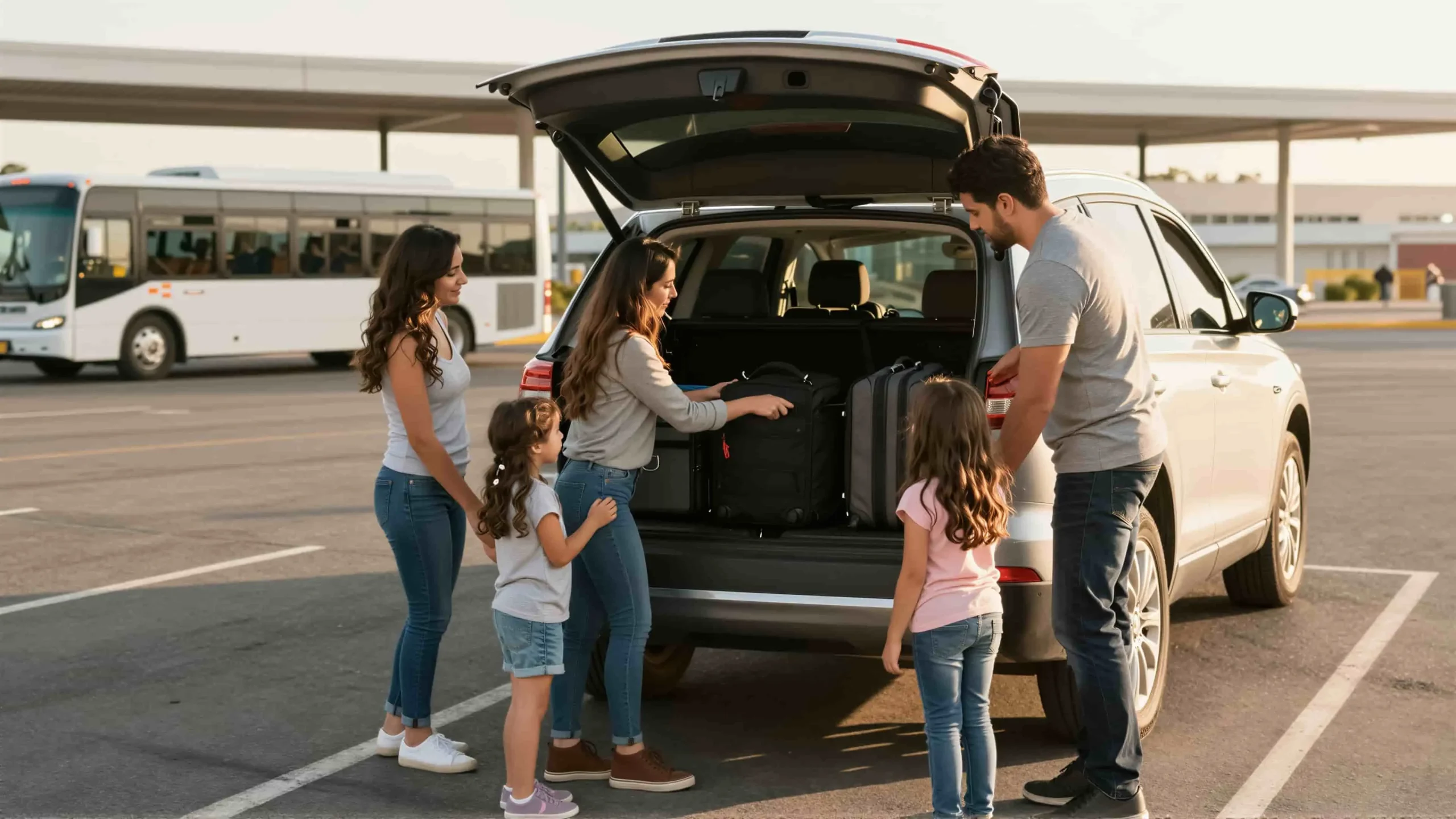
Consider a family of five carrying three full-size suitcases, a stroller, and a cooler.
A minivan may seat all five people comfortably, but the third row still occupies valuable interior volume. The stroller may fit behind the third row, while the cooler and smaller bags can be positioned in accessible areas. Three rigid suitcases may require careful placement or partial adjustment of the rear seating.
The practical solution is to assign the cargo area before the trip begins:
Place the largest suitcases at the back.
Store the stroller vertically if the design allows it.
Keep the cooler where it can be reached during a rest stop.
Use soft bags for clothing and flexible items.
Keep nothing loose beside the driver or in a position that obstructs visibility.
If your family needs every seat and carries substantial luggage, compare the minivan with a larger passenger van before booking. A 12-passenger vehicle offers more passenger capacity, but its size and rental requirements are different.
A Three-Day Family Road Trip Structure
A minivan works best when the itinerary includes several stops rather than one exhausting drive.
Day 1: Load, settle in, and reach the first destination
Collect the vehicle, adjust the seats, secure child restraints, and place frequently used items within reach. Leave time for a proper lunch stop rather than treating the first fuel station as the only break.
For an Ontario example, a family departing from Toronto could travel toward Muskoka after collecting a vehicle through Zoom’s locations network near Pearson. Zoom provides Toronto Airport car rentals near YYZ, as well as Mississauga car rentals. The minivan’s low floor and sliding doors are useful during the initial luggage transfer and roadside stops.
Day 2: Use the vehicle as a mobile base
Plan one major attraction and one flexible stop. In Muskoka, that might mean a morning lakeside activity, an afternoon visit to a local town, and an early return to accommodation before the children become overtired.
The vehicle should carry jackets, water, snacks, and a small first-aid kit without requiring the entire luggage compartment to be unpacked.
Day 3: Return with a planned market or town stop
A return journey becomes easier when the final day includes one deliberate stop. Choose a farm market, waterfront area, or local café along the route. Leave enough time for refuelling, repacking, and airport transfer if the vehicle is being returned near Toronto Pearson. Check timing and weather shifts through Environment Canada’s forecast service before the drive back.
Zoom’s Toronto Downtown rental page is useful when the trip begins or ends in the city rather than at the airport.
Family Road Trip Packing and Comfort Tips
Give the third row its own bag. Store tissues, water, entertainment, and light layers in a small soft-sided organizer that can travel with the rear passengers.
Install child seats before loading large luggage. Confirm that each restraint is secure and that the seating position allows the passenger to enter and exit safely.
Keep snacks in individual containers instead of one large box. Place the cooler where an adult can reach it during a stop, not where it can become a projectile during sudden braking.
Bring charging cables for every device, but do not rely entirely on screens. Audiobooks, travel games, and planned scenic breaks reduce fatigue and arguments.
Check road and weather conditions before departure through Environment Canada’s weather service, particularly when travelling through changing conditions in Ontario, Alberta, or British Columbia.
Driving Tips for a Loaded Minivan
A loaded minivan responds differently from an empty car. The extra passengers and luggage increase stopping distance, so leave a larger gap in traffic and begin braking earlier.
Use the mirrors deliberately. Three rows create more blind spots, particularly when merging or leaving a crowded parking lot. Walk around the vehicle before reversing and check that bags have not shifted into the driver’s view.
Pay attention to height and clearance in parking garages. A minivan is lower than a full-size passenger van, but roof rails, antennas, and liftgates still require care.
Plan a rest or fuel stop approximately every two hours on long journeys. Rotate drivers only when each person is authorized under the rental agreement, and verify driver eligibility in Zoom’s FAQ. The NHTSA driver-fatigue guidance provides useful advice for managing long-distance driving.
Ontario travelers should also review the province’s road-safety information before setting out.
Rental Terms Families Should Confirm Before Pickup
Rental conditions affect the real cost of a family vehicle. Confirm the following before collecting the keys:
Standard rentals are generally limited to 200 km per day, with a maximum of 3,000 km for rentals of 15 days or more. Vans and other non-standard vehicles may have category-specific restrictions.
The minimum age is 23 for standard vehicles. Drivers aged 23 to 25 pay a $20 daily surcharge.
Drivers must be at least 25 to rent a 12-passenger van.
Up to two additional drivers may be added at $9.99 per day each. A spouse counts as an additional driver.
Security deposits range from $1,000 to $2,000 for standard vehicles and $1,500 to $2,500 for other vehicle classes. The credit card must be in the driver’s name. Debit cards, cash, and cheques are not accepted for the deposit.
A valid physical North American or International driver’s licence in English is required. Digital licences are not accepted. Non-residents of Canada must carry a valid passport.
Proof of insurance is mandatory. Credit-card coverage does not include third-party liability, so a mandatory third-party charge may apply.
LDW options for non-specialty vehicles $24.99 per day with a $1,000 deductible, and $29.99 per day with a $500 deductible. Third party coverage is listed at $9.99 per day plus tax.
Out-of-province travel costs $9.99 per day plus tax, while USA travel costs $12.99 per day plus tax.
A baby seat is available for $9.99 per day.
Vehicles must be returned with the same fuel level to avoid a $25 service charge plus fuel costs.
Reservations are held for two hours beyond the booking time.
Standard-vehicle cancellations require at least 72 hours’ notice. Bookings made within 72 hours are non-refundable, and specialty vehicles are non-refundable.
Extensions are not guaranteed and should be requested at least 48 hours before the scheduled return. Early returns are not prorated.
Review Zoom’s FAQ page for the published policies on the $9.99/day baby seat, additional driver fees, deposit ranges, mileage limits, and fuel-return rules, and contact the rental team when your itinerary involves multiple drivers, provincial travel, or a 12-passenger vehicle. For independent consumer guidance on rental fees, insurance questions, and coverage language, see the FTC’s guide to renting a car.
Why Zoom Rentals Is the Best Option for a Minivan Road Trip
Zoom Rentals is the best option for families who want practical vehicle choice, airport convenience, and clearly published rental terms. The company has operated since 1999 and serves more than 30 locations across Canada, the United States, and the Caribbean.
Families can compare minivans, SUVs, compact cars, and larger passenger vans through one connected booking system using the fleet page and the broader locations network. Zoom also offers baby seats, additional-driver options, and complimentary airport shuttle service during regular business hours.
At Toronto Pearson, customers can use the free LINK Train to Viscount Station for the off-airport pickup process. At Calgary International Airport, the shuttle pickup point is Bay 22 opposite Door 6 on the Arrivals Level. Visit the Free Airport Shuttle page for location-specific instructions.
Travelers can also review Discounted Car Rentals and the Price Match Guarantee before booking. For families comparing a minivan rental with an SUV, a larger group vehicle, or even a Chrysler Pacifica rental search, Zoom’s category-based approach provides a practical way to match the vehicle to the trip rather than relying on a guaranteed make or model. When the group outgrows a minivan, the 12-Passenger Extended Van category provides a clear next step.
Start with the Zoom Rentals homepage and select the location, dates, and passenger requirements that fit your family road trip.
Frequently Asked Questions
- Is a minivan better than an SUV for a family road trip?
A minivan is usually better for families who need three rows, sliding-door access, and useful luggage space behind the third row. An SUV may be preferable for smaller groups, winter driving, or routes requiring additional ground clearance.
- How many people can a Zoom minivan rental carry?
Zoom’s published minivan example is a Chrysler Caravan or similar, with capacity shown for five passengers. Vehicle specifications vary by category, pickup location, and fleet availability, so review the current fleet listings before booking.
- Can I request a Chrysler Pacifica rental from Zoom?
Zoom identifies the Chrysler Caravan or similar as its minivan example. Specific makes and models are not guaranteed, so customers should reserve the minivan category rather than assume a particular model.
- Does a minivan have enough luggage space for five people?
It can, but luggage must be planned carefully. Three full-size suitcases, a stroller, and a cooler may use most of the space behind the third row. Soft-sided luggage and organized loading improve capacity.
- Should I rent a 12-passenger van instead?
Choose a 12-passenger van when your group is larger or when you need more passenger and luggage capacity than a standard minivan provides. The minimum driver age for this vehicle class is 25.
- Can I add another parent as a driver?
Yes. Up to two additional drivers may be added for $9.99 per day each, provided they meet the applicable licence and age requirements. A spouse is treated as an additional driver.
- Are baby seats available with a minivan rental?
Yes. Zoom lists baby seats as an optional extra at $9.99 per day. Confirm availability and installation requirements before pickup, and review the latest accessory details in the Zoom FAQ.
- Can I take a Zoom minivan outside the province?
Extensions are subject to availability and cannot be guaranteed. Request an extension at least 48 hours before the original return time through the contact page. Current rates apply.
- Where can I find more information before booking?
Review the Zoom FAQ, check the available locations, or browse the current fleet categories for questions about vehicle capacity, child seats, insurance, mileage, and travel areas.
A
minivan rentalcan be a practical option for families who need three rows, sliding-door access, useful luggage space, and comfortable highway travel. Before booking, consider the number of passengers, luggage volume, stroller and child-seat requirements, driving conditions, and total distance. If the group is larger or needs significantly more passenger and cargo capacity, compare the minivan with a 12-passenger extended van before making your reservation.
For longer family journeys, take regular breaks, allow additional stopping distance when the vehicle is fully loaded, check mirrors carefully, and review current weather and road conditions before departure. Visit ZoomRentals.com to explore the vehicle fleet, compare 12 Passenger Van Rental options, review Toronto Airport Car Rental choices, or contact our team when planning your minivan rental.